
Dred Scott
March 6th marks the anniversary of an egregious example of judicial overreach.
The history of the Supreme Court is littered with decisions that show how far removed the Court can be from such mundane considerations as justice and humanity. A fair few of those decisions have also been highly suspect when examined purely in legal terms.
Taken from any angle, the case of Dred Scott v. Sandford (1857) arguably marks the nadir of the country’s highest judicial body. In Dred Scott, the U.S. Supreme Court ruled that people of African descent, whether enslaved or free, were not citizens of the United States and therefore could not sue in federal court.
The Missouri Compromise
To understand the ambition and the full impact of the Dred Scott decision, we must first take a step back and focus on the Missouri Compromise.
When the territory of Missouri applied for statehood in 1819, the United States was made up of 11 free states where slavery was prohibited or in the process of being phased out, and 11 slave states where slavery was legal.
Missouri was a slave state and its admission would tip the balance in the Senate in favor of slaveholding states. Northern legislators feared that this would lead to expansion of slavery, while Southern legislators insisted that slave states had equal rights in the Union.
Henry Clay, Speaker of the House of Representatives, proposed a way to defuse the conflict through a three-part agreement: Missouri was to be admitted as a slave state; at the same time, Maine would be admitted as a free state to preserve the balance of power in the Senate; and slavery was to be prohibited in the remaining Louisiana Purchase territory north of latitude 36°30′, except in Missouri.
This agreement came to be known as the Missouri Compromise; it also helped earn Henry Clay, who went on to have a hand in the Compromise of 1850, the title of “The Great Compromiser.”
A brilliant compromise leaves everyone feeling that they got the best deal possible considering the circumstances. Most compromises, however, leave people feeling that they had to give up something they valued in order to keep something else they valued. The Missouri was the latter sort of compromise.
Put a pin in this, because we are on a path that will circle back.
Dred and Harriet Scott
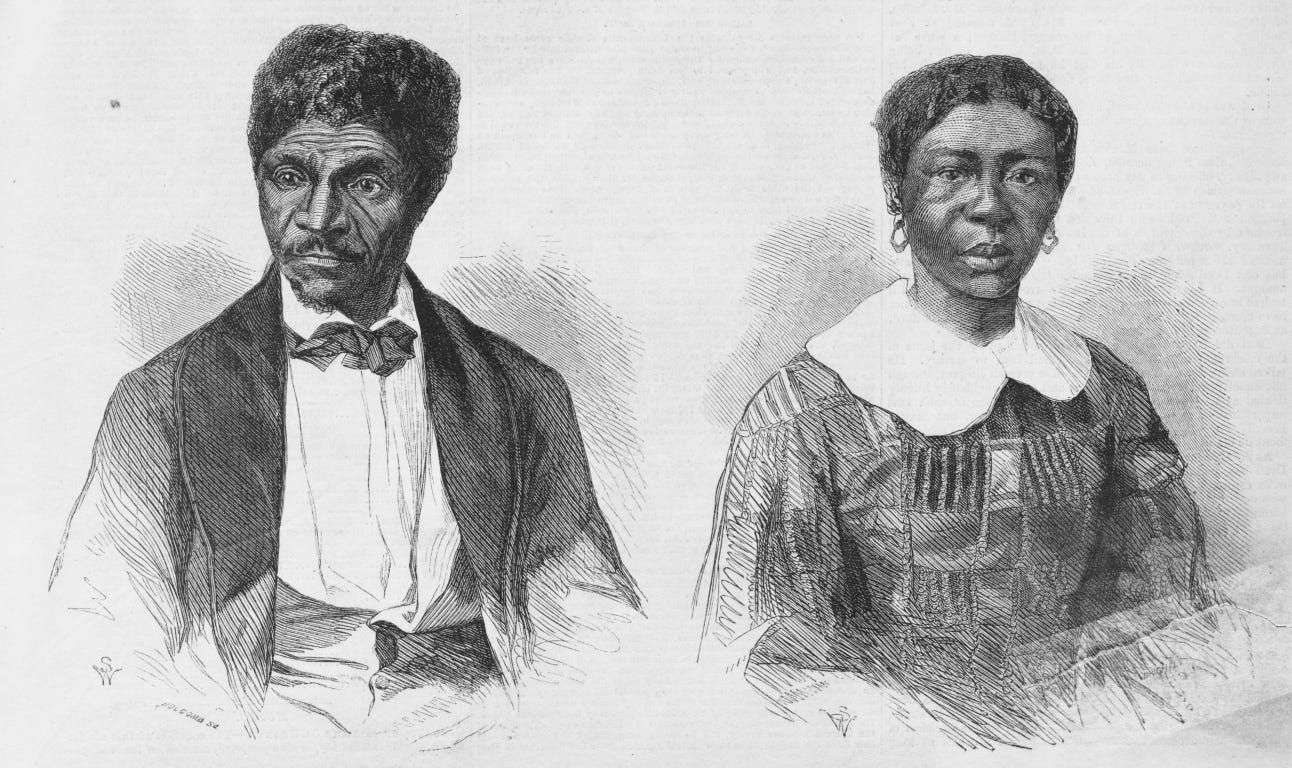
Dred Scott was born into slavery in Virginia in 1799. Around 1831 he was sold to Dr. John Emerson, a surgeon who served in the United States Army. As part of his duties, Emerson moved frequently and took Scott with him.
In 1833, Emerson was posted to Fort Armstrong, Illinois. In 1837, he was posted to Fort Snelling in the territory of Wisconsin (now Minnesota). Both Illinois and the Wisconsin Territory were free states.
It was at Fort Snelling that Scott met and wed Harriet Robinson. Harriet Robinson Scott had also been born into slavery in Virginia, and been moved around the country by her enslavers.
In 1840, the Scotts were moved back to the slave state of Missouri.
After Emerson died three years later, his widow Irene inherited his entire estate including the Scotts.
In 1846, after Dred Scott had tried to buy his family’s freedom from Irene Emerson and been turned down, he and Harriet filed separate freedom suits to gain their freedom and that of their two daughters. Those two suits, filed in the St. Louis Circuit Court, were later combined by the courts.
“Once free, always free”
The Scotts had a strong case, based on precedents set in Winny v. Whitesides (1824) and Rachel v. Walker (1836). Many other enslaved people had won their freedom because of these precedents set by the Missouri Supreme Court.
Winny v. Whitesides established a precedent known as "once free, always free.” The court ruled that enslaved people taken by their owners to reside in free states or territories became legally free and could not be re-enslaved upon returning to a slave state.
This precedent was strengthened in Rachel v. Walker, which ruled that an Army officer's military duties did not grant him a "necessity" to hold slaves in free territory, thus forfeiting his ownership rights if he took an enslaved person to a place where slavery was prohibited.
The Scotts won their freedom suit in the lower courts. Irene Emerson appealed and, in 1852, the Missouri Supreme Court overturned the lower court’s decision tossing out 28 years of precedent in the process.
Dred Scott v. Sandford
In 1853, Dred Scott sued for his freedom once more, this time in federal court. By this time, Irene Emerson had moved to Massachusetts and transferred ownership of the Scotts to her brother, John Sanford. In a clerical error, Sanford’s name was misspelled as “Sandford” and Scott’s suit was thus recorded as Dred Scott v. Sandford.
By 1856, the case had wound its way to the Supreme Court of the United States where most of the justices were from families of enslavers.
In 1857 Chief Justice Taney read the decision. It was 7-2 against the Scotts.
The majority held that “a negro, whose ancestors were imported into [the U.S.], and sold as slaves” could never be American citizens.
With this decision, the Court denied citizenship to all four million enslaved men, women and children in the country.
The Court also ruled that because the Scotts were not citizens, they had no right to sue in federal court.
This meant that, technically, the US Supreme Court had no jurisdiction in the case before them.
Undoing the Compromise
At this point, the Court could have—and legally should have—acknowledged that because it had no jurisdiction, it could not rule on the broader constitutional issues in the case.
Not this Court! It was itching to go further.
The majority went on to rule that enslaved people were legally property and because under the Fifth Amendment Congress cannot deprive someone (a citizen) of property without due process, therefore, banning slavery in the territories violated slaveholders’ Fifth Amendment rights.
The ruling implied that slavery could legally exist anywhere in U.S. territories, not just in the South.
The Missouri Compromise, the Court declared, was unconstitutional.
A mangled ruin
The decision in Dred Scott v. Sandford brought heartbreak and tragedy to the Scott family and to the families of all those enslaved.
It was also a constitutional and political earthquake.
Shortly after the ruling, Abraham Lincoln delivered a speech on the decision, in part:
I think the authors of that notable instrument [the Declaration of Independence] intended to include all men… but I think the Judge [Taney] is not quite accurate in saying that the authors of the Declaration intended to include all men, but did not include negroes…
The assertion that ‘all men are created equal’ was of no practical use in effecting our separation from Great Britain; and it was placed in the Declaration not for that, but for future use.
Its authors meant it to be… a stumbling block to those who in after times might seek to turn a free people back into the hateful paths of despotism… so that today… it may not be a mangled ruin.”
Another path to freedom
After the Court’s ruling, the Emersons deeded the Scotts to Republican congressman, Henry Taylor Blow.
Despite being raised in the South, Blow was an abolitionist. In fact, his family had at one time owned Dred Scott and, when Scott sued in court, Blow helped finance the suit.
In 1857, Blow manumitted the Scott family. Dred Scott died several months later. Harriet outlived him by 17 years.
For your calendar

Honestly Rose, I learned more about Dred Scott from this history review than I did in my high school American History class! Thanks so much for the research and time you put into it. On another note, Graphic will be on sale at five out of five venues when Sr. Helen is here. Doing all we can to sell the daylights out of that fabulous six-year project of yours! I so wish you could hear all the comments coming my way.
That was a fantastic summary, Rose. Most non-historians are unaware of the legal battles pursued by enslaved people and their advocates. It is reminiscent of the failures in the criminal "justice" system experienced and described by Calvin and Sophie in their book. Of course, I am eagerly awaiting your appearance at the book festival!