
Plessy v. Ferguson
This week marked the 130th anniversary of one of the Supreme Court's most egregious decisions.
Once again this week there’s a lot to write about, so I’m going to start with the two heavier pieces, one about a case from 130 years ago that constitutionalized segregation, the other about a failed execution that happened just this week. After that, I have two lovely closers to lift you.
Plessy v. Ferguson
When you want to bring a test case — a case that establishes a new legal principle or clarifies an ambiguous law or challenges the constitutionality of existing legislation — it’s vital that you select the perfect litigant.
In 1892, the Comité des Citoyens in New Orleans decided that a local shoemaker and insurance agent, Homer Plessy, was the person they needed to challenge the state’s Separate Car Act.
The Separate Car Act of 1890 was one of the many laws introduced after the demise of Reconstruction (I wrote about this last week), when Southern whites were determined to reassert their dominance over Blacks. The law required railroads to provide separate cars for Black and white people.
The man they chose
Homer Plessy was born in New Orleans on March 17, 1862 — in the middle of the Civil War — into the city’s community of free people of color. Before the war, this community, especially Creoles of color, had occupied a complicated social position: many were educated, French-speaking, Catholic, and economically established, though still constrained by the racial hierarchies of the time.
Plessy worked as a shoemaker and later as an insurance agent — respectable, skilled occupations within New Orleans’ Black and Creole middle class. Nothing suggests he sought fame. He was quiet and dignified rather than flamboyant or confrontational, which made him, if anything, more useful to the Comité’s purposes. This was not a case that needed a firebrand at its center.
Under Louisiana law, Plessy was classified as an “octoroon” — a term from a racial taxonomy museum, a sliding scale of racial mix — meaning someone with one-eighth African ancestry. But physically, he appeared white.
That was the whole point.
The Comité des Citoyens
The Comité des Citoyens — Citizens’ Committee — was a group of Black Creoles, activists, and white allies in New Orleans determined to challenge segregation laws through the courts. They were deeply influenced by Reconstruction-era constitutional ideals and believed the new laws could be fought with legal strategy rather than street protest.
Much of their work was organized by Louis Martinet, a Creole lawyer and editor of the newspaper The Crusader, who corresponded extensively with Plessy’s lead counsel in New York. The Comité’s approach was sophisticated and methodical: they would expose the irrationality of racial classification by selecting a plaintiff whose race could not even be reliably observed.
The Comité chose Plessy with extraordinary care, and for interlocking reasons. He could pass as white, which was theatrically essential to the strategy. He was respected and dependable enough to carry a carefully orchestrated legal case through to its conclusion without being rattled. He occupied a strategically ambiguous social position — as a member of New Orleans’ long-established Creole community, he didn’t fit neatly into the rigid racial binary Jim Crow was trying to impose. And as a skilled worker with some economic stability, he had a degree of resilience against the personal consequences of arrest and public scrutiny.
Challenging segregation in the 1890s carried real personal and economic risk. Plessy’s willingness to take that risk, combined with his temperament and social position, made him the Comité’s man.
The setup
The arrest itself was not an act of spontaneous civil disobedience. It was a performance with a precise script, staged for a legal audience.
Plessy bought a first-class ticket. He boarded the whites-only car on the East Louisiana Railroad. He announced his racial identity to the conductor. And, when asked, he refused to move. A private detective, hired by the Comité, was present to ensure the arrest unfolded under exactly the right legal conditions.
Even the railroad was in on it. The East Louisiana Railroad was not a reluctant victim of the Comité’s scheme; it quietly cooperated. In post-Reconstruction Louisiana, some companies were occasionally less enthusiastic about segregation than the politicians who mandated it. Jim Crow was not merely custom bubbling up from society — it was aggressively engineered through law, and those bearing the operational cost of that engineering sometimes resented it. Railroads disliked the cost of running segregated cars.
The argument in court
The Comité had retained as their lead counsel Albion Tourgée.
Tourgée was a Union veteran who had taken a bullet at Bull Run, a “carpetbagger” judge in North Carolina during Reconstruction, and a popular novelist — his A Fool’s Errand was a bestseller. He took the Plessy case without fee.
Tourgée’s brief was brilliant. He argued that the Separate Car Act violated both the Thirteenth Amendment, which had abolished slavery, and the Fourteenth Amendment’s guarantee of equal protection. But his most striking argument was one that historians still chew over: he claimed that Plessy’s near-whiteness was a form of property, and that being publicly designated Black deprived him of the reputational value of whiteness without due process.
That sounds strange to modern ears until you unpack what he meant. In the segregated South, whiteness brought access to better facilities, to mobility, to safety, to employment, to credibility, to voting power. Blackness triggered exclusion, surveillance, and peril. Tourgée was exposing the hidden economic machinery of race: “white” was not merely an identity, it functioned like a credential, almost a form of inherited capital — and the law was confiscating it from Homer Plessy without compensation.
The brilliance of the argument lay in the trap it set. Tourgée was forcing the Court to confront a contradiction: if segregation imposed no stigma — as its defenders claimed — then why would it matter whether Plessy was classified as white or Black? The very need to police racial boundaries revealed that whiteness possessed state-protected value.
Tourgée also made a broader point: if race could not even be reliably observed, the entire system required surveillance, ancestry policing, and legal invention to function. The South had built a “natural order” that, in fact, required a bureaucracy wielding spectral rulers to measure invisible fractions of ancestry.
The phrase that would eventually become the most quoted line of the case — “Our Constitution is color-blind” — came not from the bench but from Tourgée’s brief. It was his. Justice Harlan would borrow it.
A Northerner writes Jim Crow
The case first went before John Howard Ferguson, a Massachusetts-born judge sitting on a New Orleans court. Despite his Northern origins, Ferguson ruled against Plessy, finding that the state had the authority to regulate railroads within its borders. The case then wound its way upward, eventually reaching the Supreme Court.
The Supreme Court ruled against Plessy on May 18, 1896, in a 7–1 decision. (Justice David Brewer did not participate. His daughter had just died, which is why the vote was 7–1 rather than 8–1.)
The majority opinion was written by Justice Henry Billings Brown, a Yale-educated Massachusetts man. It is one of history’s more pointed ironies that the South’s constitutional charter for racial apartheid was authored by a Northerner.
Brown’s majority opinion upheld the Louisiana law. It held that the Fourteenth Amendment guaranteed political and civil equality, but not “social” equality. Laws separating the races, the Court insisted, did not by themselves imply the inferiority of either race. Any sense of inferiority felt by Black people, Brown wrote, came only because they chose to “put that construction upon” the law. The segregation was, by this logic, neutral, not an enforced caste system.
While it is Plessy v. Ferguson that gave us the doctrine of “separate but equal,” the Court itself didn’t use that phrase. The Louisiana Separate Car statute had used the term “equal but separate” and the Supreme Court echoed that phrasing.
The dissenter
The lone voice of opposition came from Justice John Marshall Harlan.
Harlan was a former slaveholder from a prominent Kentucky family. His half-brother, Robert Harlan, was a mixed-race man who became a wealthy figure in Cincinnati Republican politics. Harlan had also been the sole dissenting voice in the Civil Rights Cases of 1883, when the Court had gutted the Civil Rights Act of 1875. His Plessy dissent was not a sudden conversion but the continuation of a fifteen-year pattern.
He wrote that the majority’s ruling would prove “as pernicious as the decision made by this tribunal in the Dred Scott case.” The Thirteenth and Fourteenth Amendments, he argued, had created a color-blind Constitution, and the Court was now making a mockery of them. And here he deployed Tourgée’s phrase, the one from the brief, the one that would echo through the next century: “Our Constitution is color-blind, and neither knows nor tolerates classes among citizens.”
Yet even in dissent, Harlan’s moral vision had limits. In the same opinion, he expressed alarm that Chinese immigrants, “a race so different from our own,” might one day exercise civic equality with white Americans. Harlan had, in the same breath, drawn his own line.
The response
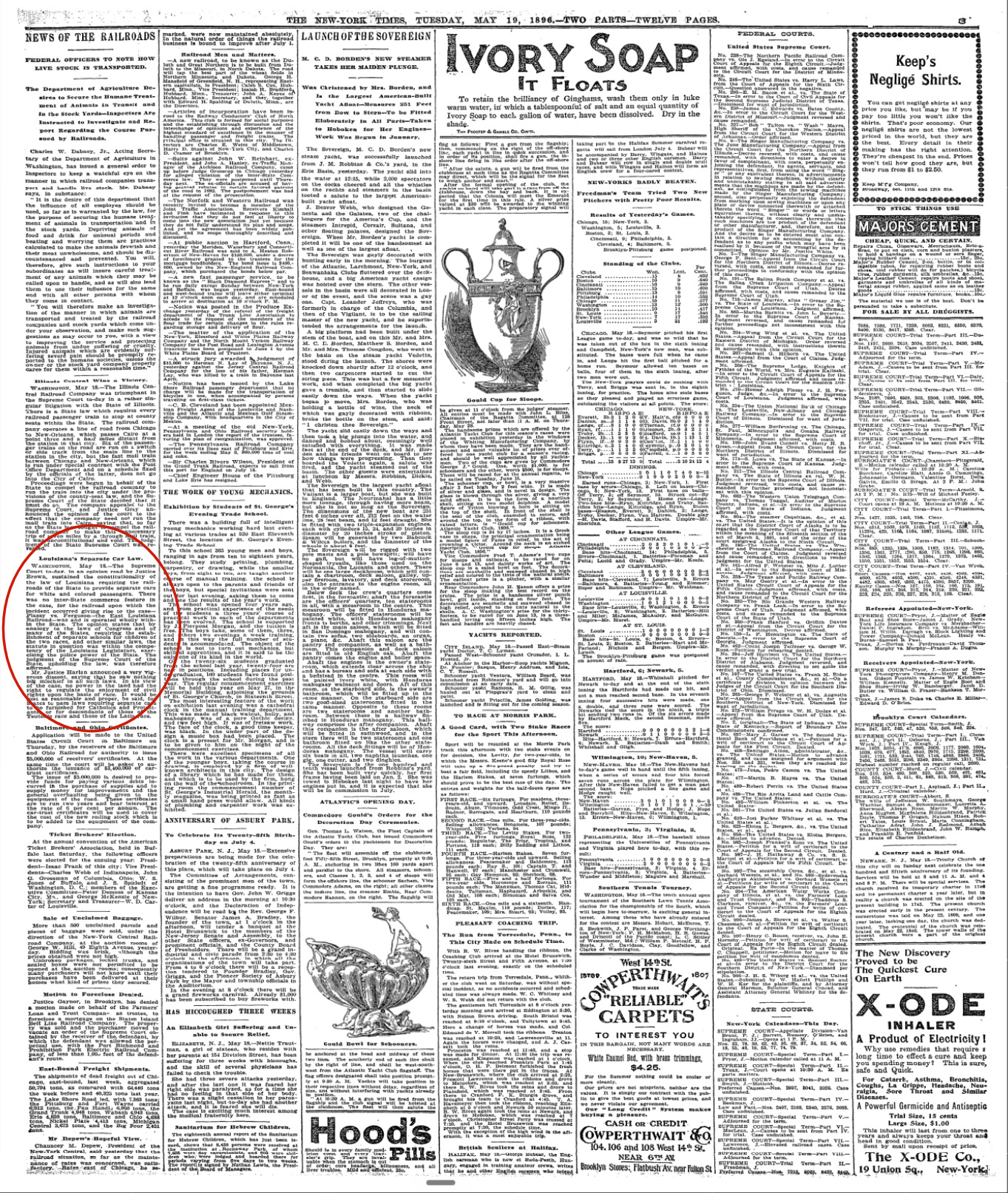
The white mainstream press treated the ruling as a minor administrative matter. The New York Times tucked it onto an inside page, underneath railway news. The Black press, however, condemned it forcefully.
The Comité des Citoyens issued a defiant statement, essentially declaring: we lost in court, but we did not lose our conviction that we were right. Then they disbanded, having spent themselves financially and organizationally on the effort.
Frederick Douglass had died the year before and so didn’t live to see the ruling. Ida B. Wells and others kept pressing at its consequences.
Booker T. Washington’s accommodationist Atlanta Compromise* speech had come just months before the decision, and Plessy v. Ferguson effectively constitutionalized the world he was telling Black Americans to accept for the time being.
W.E.B. Du Bois would later treat the ruling as the formal closing of Reconstruction’s promise.
“Separate but equal” was almost immediately a fiction. Southern states routinely underfunded Black schools, hospitals, rail cars, and public services. The equality existed mostly on paper. One Louisiana Black newspaper reportedly called the ruling a “thin disguise” for caste legislation. Many African Americans saw at once what the Court refused to admit: segregation itself stamped one group as inferior.
Plessy v. Ferguson stood as binding precedent for nearly sixty years, legitimizing Jim Crow across the South — segregated schools, transportation, restaurants, water fountains, hospitals, cemeteries — until Brown v. Board of Education overturned it in 1954, at least in the context of public education. Subsequent rulings dismantled segregation in other domains. But for the intervening decades, the doctrine of “separate but equal” gave legal cover to one of the longest and most systematic programs of racial oppression in American history.
And what of Homer?
Homer Plessy did not go to prison. After his constitutional challenge failed, he pleaded guilty and paid a $25 fine. He returned to ordinary life in New Orleans while segregation deepened across the South around him. He married twice — his first wife, Louise Bordenave, died relatively young, and he later married Harriet Benoit. He had no children. He died in 1925 at age 63.
For decades, his grave and his story received relatively little public attention. He had become, as one writer put it, almost anti-mythic — the ordinary man on whom an enormous constitutional catastrophe had turned. Only later did he begin to be recognized as a foundational figure in the long struggle against segregation. In 2022, Louisiana’s governor, John Bel Edwards, issued a posthumous pardon.
In a fitting historical symmetry, the Plessy and Ferguson Foundation — dedicated to reconciliation and justice — was co-founded by descendants of both Homer Plessy and Judge John Howard Ferguson, the local judge whose ruling sent the case on its way to Washington.
* Booker T. Washington argued in his Atlanta Compromise speech that Black Southerners should, for the time being, accommodate segregation and set aside demands for full political equality, including voting rights, in exchange for basic legal protections and greater access to property ownership, employment, and vocational and industrial education.
Timeline of a failed execution
On May 21st, Tennessee attempted to execute Tony Carruthers by lethal injection. The attempt failed.
To understand the torture that Mr. Carruthers underwent, it’s worth going through the timeline of the failed attempt:
10:00 a.m. – The execution is originally scheduled to begin but experiences brief initial delays as legal teams await the Supreme Court’s final decision. Mr. Carruthers is already in the execution chamber at this time.
10:24 a.m. – Medical personnel enter the execution chamber and begin trying to establish venous access.
10:31 a.m. – After three or four unsuccessful punctures, personnel struggle to access a vein in Carruthers’ right arm. The technician notes that his “veins were rolling.”
10:41 a.m. – A primary IV line is successfully secured in Carruthers’ right arm. Per state protocol, a viable backup line must also be established.
10:43 a.m. – Personnel attempt to place the backup line in his left arm six to seven times. The technician shakes his head, indicating the line is not flowing and is failing to infiltrate.
10:48 a.m. – Personnel attempt to insert an IV into Carruthers’ left hand. Carruthers visibly winces as the technician grunts while pushing the needle, but the line fails to flow.
10:54 a.m. – A doctor enters the chamber. Carruthers’ socks are removed so personnel can use a “vein finder” light over both of his feet; no suitable veins are found.
Late Morning Sequence – A final attempt is made to insert a central line directly into Carruthers. His attorney describes the continuous failed punctures as Carruthers being “stabbed” multiple times. Riverbend Warden Kenneth Nelsen instructs the struggling doctor to “do your job, sir.”
11:40 a.m. – Carruthers’ legal team confirms publicly that the state has been unable to successfully deliver the fatal dose of pentobarbital.
11:52 a.m. – Executioners officially remove the intravenous lines from Carruthers. A staff member informs him he is being taken back to his cell.
12:40 p.m. – The Tennessee Department of Correction officially calls off the execution.
1:00 p.m. – Governor Bill Lee issues an executive statement granting Carruthers a temporary one-year reprieve from execution, pushing any potential future execution dates into 2027.
The one-year reprieve granted by Gov. Lee is, in itself, quite extraordinary, and underscores the horror of this failure.
I’ll return to this in a future issue, because it harks back to the double execution of Willie Francis, which we write about in Dead Man Walking: Graphic Edition.
Illumination is the job
You can hear a lovely, extended interview with Catherine Anyango Grünewald, illustrator of Dead Man Walking: Graphic Edition, on the latest edition of the Beyond the Habit podcast.
After working together and zooming frequently for more than six years, I miss our regular chats, and so it’s a real delight to hear Catherine’s voice. And, as always, whenever Catherine talks about illustration, her passion for art, and her passion for her students, it’s worth listening.
Here’s an edited snippet from the interview:
Question: What words of wisdom or encouragement might you offer to other artists to empower them, to believe in that gift and use that gift and see it as an incredible way to be a prophetic storyteller in our time?
Catherine: I’ve been teaching for 20 years, so I’ve had a lot of students and they are super interested in changing the world or they are super affected by things that go on in the world.
Our students are very empathetic, but I notice that they shy away from making work explicitly about the things that affect them, the things they want to change.
That is because there is a big pressure when you’re working with this kind of subject to get it right. Also, I feel that there is the implication that by tackling such a subject, you have to solve it.
That is what stops people.
But I always tell my students, you don’t have to solve the problem. You can direct people’s attention to something, that is your role and that’s where your skills come in. And then they find it much easier to start engaging with this kind of material.
I think that it’s easy to assume that you have to solve something by engaging with it; every person doing their small thing is really what works.
I saw this through Sister Helen…she was telling me about when she put out the book [Dead Man Walking] and she would go talking everywhere -- there was no place too small; there was no place too big. And she did not discriminate.
So I think I would also tell students, it doesn’t matter how many people you reach or touch, as long as you do it with your heart.
Poetry contest winners
I mentioned a while back that I had been chosen as one of the judges of the Catholic Mobilizing Network’s Justice & Mercy Poetry Contest.
I really enjoyed the whole process, reading the poems, hearing each one read out loud during judging, and getting to discuss them and their impact with the other judges.
The winners have now been announced and you can meet them and read the winning poems on CMN’s website.
Here’s a snippet from Kate Letterman Conway’s first-placed poem, And Still.
I am no Mary, / My son is certainly no Jesus, / And still, I can’t help but feel connected, / Can’t help but wonder, / Is this how she felt / Witnessing her son, / Being prodded to his death, / The shame, the humiliation?
Fascinating story and what a brave man to risk so much.
As a law student many decades ago, as a native Southerner in law school in my hometown of New Orleans, I remember being horrified by the Plessy v. Ferguson case, and also wondering why we were not taught about this in high school. I suppose it was too close to home for them to teach us that one of the worst decisions in the history of the United States Supreme Court was from Louisiana. I was so pleased that we finally erected a historical monument to this in Louisiana. Too bad that the plaque hasn’t translated into action by our state legislature, courts, and many of our citizens. Thank you for writing about this.
As always, it’s good to read about some good things in your column, too. I liked reading the snippet from Catherine. What a wonderful educator she is. And I am happy that the man in Tennessee has been given at least a one year reprieve from execution- but disgusted that it’s because he went through the torture of a botched execution attempt. How barbaric.